How We Took Claude Code Adoption From 1% to >92% Across 150 Engineers
Like many organisations today, we were looking at AI as a way to accelerate our business: meaning faster delivery, more capacity and less…
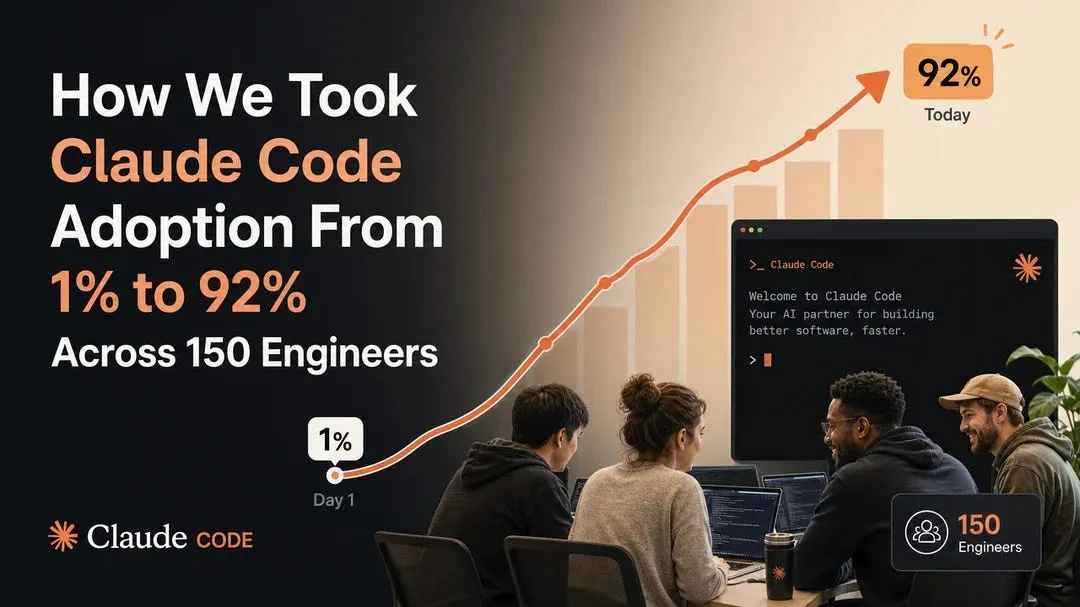
Image generated by AI
Like many organisations today, we were looking at AI as a way to accelerate our business: meaning faster delivery, more capacity and less time lost to repetitive work.
On the flip side, as an engineer you are seeing posts from LinkedIn wizards about how your role is going to be replaced and you are no longer needed by a company where you used to have an impact. This can of course create some friction between the direction of a company and their employees.
I did not think the answer was to ignore AI, or to force it on people, the answer was to prove it was worth their trust.
How did we manage to go from 1% to over 90%?
My perspective is that any long lasting change in an organisation needs to be bottom up. Shoving “you need to do this” down peoples throat just ends up with a lack of trust and frustration.
From an organisational perspective our goal was clear, we needed to increase our productivity and our main bet was AI. We had experimented with a variety of AI tools, but we did not see a large engagement or changes in productivity.
Personally, I had been using Claude Code for quite a while for my side projects and got increasingly impressed by the results and how well Claude performed tasks. I used this experience to get approval for a trial run of Claude Code within our organisation.
Bring in the champions
We had to figure out if the tooling helping me write side projects was actually going to perform in an enterprise organisation serving over 1 million users. So we found a handful of engineers ranging from interested people, to people with strong social capital in the organisation and formed our little group, created a private chat room and started evaluating.
At first it was a bit slow, people were still getting used to the new tool and trying out things. But after a few weeks it turned around, and we were sharing cool features and things we created with Claude Code. The word quickly spread around the organisation and people started DMing me to get access to our group chat and get a licence — this is when I knew we were onto something.
A few months in we had more and more people excited to try Claude Code. We had one of our developers present their experience with Claude to the organisation and after that it completely exploded — in a good way.
For a few days it felt like my main job was to invite people to our private chat room and assign licences.
Where we are today
More than 6 months in, we have over 92% adoption of Claude Code in our Product & Engineering organisation. As people are excited about the tool, we are seeing cool side projects and tooling that is helping engineers with administrative tasks, repositories that are filled with skills to help us code consistently using Claude.
One of our engineerings even created a dedicated AI-only repository, built with heavy harnessing of skills, documented decisions, custom scripts and CI checks. Specifically designed to enable Claude to work with minimal human intervention.
All in all, it has been truly awesome to see an organisation so excited about a new tool, sharing ideas and solving pain points and creating value both for our customers but also for us internally.
What were the results?
Besides adoption we have been seeing a huge increase in output, comparing 3 months without Claude to 3 months with Claude we are almost seeing a 2x in output.
It’s easy to confuse output with outcome, where outcome is what truly matters. I.e is the output we are generating also generating any value — and that can be hard to measure. What I can say right now, is that we have been able to deliver on more of our projects, had time to refactor old backlog items that we did not have capacity for before and seeing an increase in collaboration and tooling.
Further, the craze has spread to other parts of our organisation. We are seeing self serve financial dashboards built by our finance team, the support team providing excellent bug reports with detailed information that helps engineers resolve issues quickly.
How would I do a similar transformation next time?
Next time I am involved in a project that requires substantial change, I will set extra focus on these four topics:
Find your Champions
Finding the right people is key, and quite simple. Look for people who are genuinely interested in whatever you are doing and get them engaged in your initiative. Many key leaders are specialists and do not hold a formal manager title, these are the people you want onboard for this type of change.
Build a Community
Build a community around whatever you are introducing, chat rooms are great for this. It gives curious people a natural place to join in and ask questions.
Have Empathy
Given that social media feeds employees that their job is being replaced, you need to be empathic to that situation and have a story that explains what the organisation will look like after the transformation. People need to see their place in the future and how in this case Claude Code could offer them less administrative tasks, finally fix that refactoring they have been waiting months for and so on.
Set Guardrails
Specifically when introducing something like AI, it is important to think through what guardrails people need. Both to feel safe and to operate safely. At a minimum, that means being explicit about what data can and can not be shared with the tool, which systems or repositories are in scope, and who owns those decisions. The earlier this is defined, the less friction it causes later. Retrofitting guardrails after adoption has already taken off is a much harder task.